Buying guide
The best patio cover for Highveld storms and the Cape Doctor
South Africa gives a patio cover two very different tests: the summer thunderstorms that roll over the Highveld, and the south-easter that funnels across the Cape for days on end. Wind, more than sun, decides which cover still looks good in ten years. Here is how the options hold up.
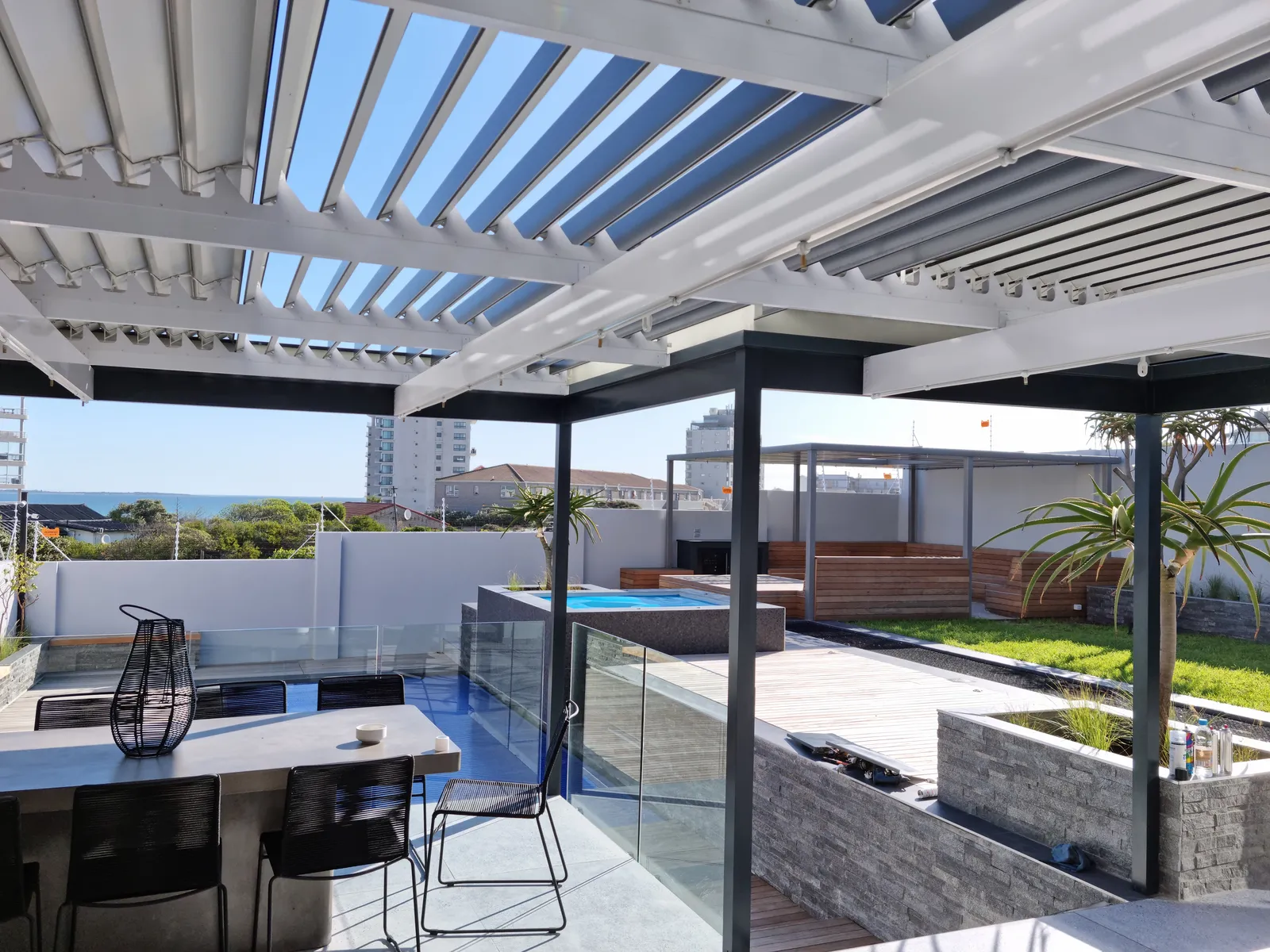
Both the Highveld storm and the Cape south-easter punish the same weak points: light frames that flex, fixings that were never engineered for uplift, and fabric that flogs itself to pieces. A cover that suits a still garden in the suburbs can be the wrong call on an exposed corner plot or a coastal stand. The trick is matching the structure to how the wind actually behaves where you live.
Why wind, not sun, is the real test
Sun fades a cheap finish, but wind is what tears a structure apart. Gusts lift a cover from underneath, work fixings loose over time, and turn any loose panel into a sail. That is why we engineer each structure to its span and site rather than fitting one size everywhere, and why the fixing method matters as much as the frame itself.
Louvre awnings: close them and ride it out
A louvre awning is the most adaptable answer to wind. The aluminium blades tilt from fully open to sealed shut, so when a storm comes in you close the roof and it sheds the rain and takes the gusts as a solid surface. On a motorised roof a wind sensor can close the blades for you when you are not home. For an exposed patio that needs to work in both still and rough weather, this is usually the cover we point people to.
Fixed aluminium covers: permanent and unfussy
A fixed aluminium IBR cover is a permanent roof with nothing to open, close or maintain. Bolted or concreted down and tied into the existing roofline, it simply stays put through a Highveld hailstorm or a week of south-easter. For a large entertainment area where you want cover and forget about it, fixed aluminium is hard to beat.
Drop blinds: stop the wind at the sides
A roof keeps the rain off the top, but wind comes in sideways. Drop blinds roll down the open sides of a patio to block the gusts, so the space stays usable when the south-easter is up. Paired with a louvre awning or a fixed cover, they turn an exposed patio into a room you can sit in on a rough day.
Fixings and frame: the part you cannot see
Whatever the cover, the wind test is won underneath. Our supports go in concreted into the ground or bolted and plated onto existing paving, chosen to suit the site. The aluminium is corrosion-free, which matters as much at the coast as inland, and the colour is baked into the metal across 23 shades so hard UV does not fade it. We have been building for South African weather since 1988, and the fixing detail is where that experience shows.
So which cover wins?
For a patio that has to handle both calm days and real wind, a louvre awning gives you the most control. For permanent, no-effort cover over a big braai area, fixed aluminium is the workhorse. Add drop blinds when the wind comes in from the side. The best answer depends on your exact spot, which is why a free site visit is the honest way to decide.
Good to know
Patio covers and wind: common questions
Which patio cover handles strong wind best?
A louvre awning, because you can close the blades into a solid surface that sheds rain and takes the gusts. A fixed aluminium cover is also excellent for permanent, no-maintenance protection. The fixing method matters as much as the cover itself.
Can a louvre awning stay open in the wind?
In normal conditions, yes. When the wind picks up you close the blades, and a motorised roof with a wind sensor can do that automatically. Closed, the roof presents a solid surface rather than catching gusts from underneath.
Do I need drop blinds as well as a roof?
Only if wind or rain comes in from the sides, which is common on exposed and coastal patios. Drop blinds roll down the open sides to block it, and roll away when you want the view back.
Is aluminium suitable at the coast?
Yes. Aluminium does not rust, so it holds up to salt air far better than steel, and our baked-on colour resists coastal UV without fading. It is a common choice for sea-facing and wind-exposed homes.
Free consultation & quote
Request a free quote today.
Tell us what you have in mind and where you are. One of our own consultants (not a call centre) comes back to you, measures on site and quotes with no obligation.
Four branches nationwide
We service all areas in Cape Town, Johannesburg, Pretoria and on the Garden Route
Local teams measure, manufacture and fit from four branches: head office in Cape Town, plus Johannesburg, Pretoria and Wilderness.